Leaving Alaska
The Land I Lost


The fumes of jet exhaust gave way to the pure, cool air, the air I’d left behind sixteen years earlier—fresh, moist, living: the air of Alaska. Outside the automatic doors at the Juneau airport, the sky was part blue, part cloud, part evergreen, and part the ridged mountains I remembered. A door to joy opened in my heart.
I was home.
~~~~~~~~~~~
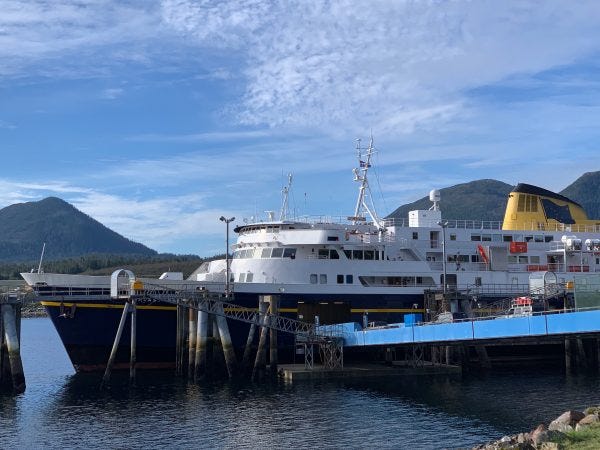
My father took a job with the Coast Guard when I was almost five, and he, my mother, and I moved to Juneau that fall after school had already started. My mother, who hadn’t thought he’d really get the job when he applied for it, hung up on him in our home in Denver when he called to tell her the news. After marrying in Kansas City, she had followed him around the country to a succession of government work, all in fascinating or beautiful places. But still, a move to Alaska was not what she had had in mind. I didn’t have an opinion, and I left my new kindergarten teacher behind me; we drove to Canada and departed for Juneau by ferry from Prince Rupert.
After living in a motel for a time, we moved into the house at 156 Behrends Avenue, my home for five years. I looked down at the row of unique houses across the street, out to the channel and Douglas Island, to a world of shade, fog, and mystery. I looked up at the back yard, in terraces, with colorful stones, batches of chives and Shasta daisies infested with spittle bugs and a green glass float that was now a gazing globe—then upward again to a few other roofs, to deep green, to rock interspersed with rivulets of snow. Then up to the wisps of white cloud which sailed quietly across the face of Mount Juneau, shifting gradually into ether, the song of float planes above my head.
There was a playground in the nest of Mts. Juneau and Roberts. We’d go there sometimes after walking the sluice above the city. Golden brown boards thudded under Dad’s waffle stompers. Fallen needles scattered across the wood, an exciting drop off the edge of the sluice that could take us into Devil’s club, moss, and fern.
Out the road, Mendenhall supplied us with blocks of blue-white ice to fill our ice cream churn. Dad always wanted to use glacier ice, said it made the treat turn out better. I can still see him poling a smallish berg in toward the beach, looking back at the camera with that pleased grin because another do-it-yourself solution had worked.
There were blueberries in the clear cut for the airport runways. We’d spend a couple hours there on a summer day, retreat from the bear who came wandering through despite the sound of our plastic dishes filled with rocks to shake, and haul our buckets of miniscule, blue treasures home to soak in salt water. Soon the tiny, bitter worms would rise to the surface to be skimmed away.
We went sledding in the cemetery across the street from my elementary school. There was still plenty of room there in the 70s and we didn’t have any trouble avoiding gravestones. Of course, the snow was usually deep enough there were no snags on the rush down the gradual hill. Snowplows churned the crystals on the roads to brown sugar all winter. I marched through them on my way to and from school, marveling at the beautiful patterns left by tires. In the depth of winter, dawn was beginning to break when I left my house in the morning with my spare key around my neck. That key once got lost outside, not to be found until spring.
Out the road at Eagle Beach or the Shrine of St. Therese, easily toppled mazes of rocks held tide pools with anemones, sea stars, and red sea urchins like stars exploding. My fourth-grade class took our field trip to Glacier Bay, selling Current calendars in advance to raise the money. Sleeping bags tossed across the floor of the LeConte, the diesel voice of the ferry grumbling below us, laughter and shrieks as we pulled up as close as the pilot would take us to the terminus of the glacier. A massive blast on the horn crumbled some of the blue beauty away.
For years after we moved away, some nights after dinner, our family would take turns reading aloud from our Collected Poems of Robert Service, often “The Spell of the Yukon.” This is true. Even though in Alaska it’s usually rainy, cloudy or foggy, in my memory it’s always sunny.
~~~~~~~~~~
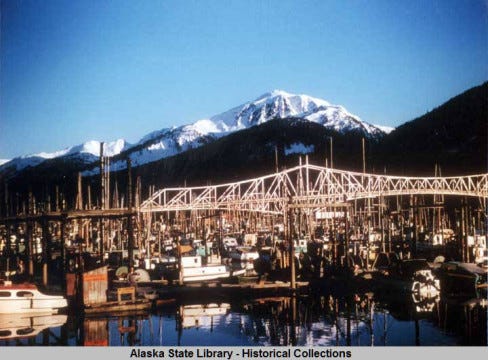
We left by ferry to the lower 48 in 1977 for a different civil service job. My last memory is discussing with my best friend Salina how to prepare scrambled eggs. We were nine and ten years old. In honor of my departure, we were allowed to spend the night together in my empty house, camping and making breakfast. I don’t remember whose conclusion prevailed: stir often, stir rarely. Sunlight streamed up my street, the boats in the harbor below a graveyard of masts, most boats at rest in a maritime forest I had become intimately familiar with. The bridge lights blinked, blinked, exuding calm in the same way incense inhabited Saint Nicholas Orthodox church.
Six months later, 2,500 miles away in Minnesota, a song on the radio left me sobbing for my lost cat, the friend I’d had to leave behind, and every other loss I couldn’t then put into words.
~~~~~~
This memoir was first published in Alaska Women Speak, Spring 2023 issue.